
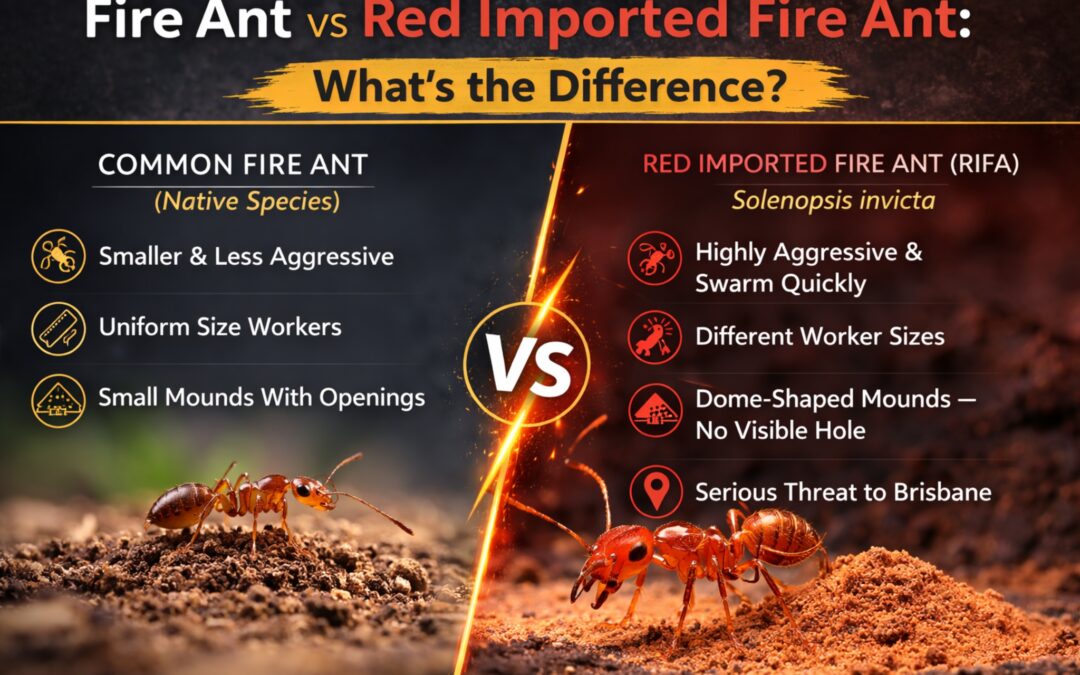
If you’ve spotted aggressive ants building mounds on your property, it’s natural to assume they’re fire ants. But here’s the important question, are they common fire ants, or are they Red Imported Fire Ants (RIFA)?
Understanding the difference between fire ants and RIFA is critical, especially here in South East Queensland. While many ants sting and build soil mounds, Red Imported Fire Ants pose a far greater threat to people, pets, businesses, and the environment.
In this guide, we’ll explain:
- How to tell the difference between fire ants and RIFA
- What Red Imported Fire Ants look like
- Why RIFA are a serious issue in Brisbane
- How professionals accurately identify RIFA
- What to do if you suspect an infestation
If you’re concerned about red imported fire ant Brisbane risks on your property, this article will help you understand what you’re dealing with.
What Are “Common” Fire Ants?
In Australia, several native ant species are commonly referred to as “fire ants.” Many of these ants:
- Are reddish-brown
- Build small soil mounds
- Deliver a painful sting
- Live in lawns, garden beds, or bushland
However, these native species are part of our ecosystem. While they can be irritating, they do not behave like Red Imported Fire Ants.
Native fire ants typically:
- Show less coordinated aggression
- Have smaller colony sizes
- Cause limited environmental damage
- Rarely spread rapidly across large areas
They may sting when disturbed, but they don’t usually swarm in the same way as RIFA.
What Are Red Imported Fire Ants (RIFA)?
Red Imported Fire Ants (RIFA) are an invasive species known scientifically as Solenopsis invicta.
They are not native to Australia. RIFA originated in South America and have become one of the world’s most destructive invasive ant species.
Here’s what makes them different:
1. Highly Aggressive Behaviour
When a RIFA mound is disturbed, hundreds to thousands of ants swarm out within seconds. They climb vertically and sting repeatedly.
Unlike many native ants that bite once and retreat, RIFA:
- Attack in large numbers
- Hold onto skin with their mandibles
- Inject venom multiple times
This coordinated response makes them significantly more dangerous.
2. Distinctive Mounds
RIFA build dome-shaped soil mounds that:
- Can grow up to 40 cm high
- Have no visible entrance hole on top
- Appear after rain or soil disturbance
These mounds are often found in:
- Lawns
- Construction sites
- Parks
- Acreage properties
- Sports fields
3. Variable Size Workers
A key feature used to identify RIFA is worker size variation. Within a single colony, you’ll find ants of noticeably different sizes (minor and major workers).
Many native ant species have workers of similar size, making this an important distinction.
The Difference Between Fire Ants and RIFA
Here’s a practical comparison to make it clearer:
| Feature | Native Fire Ants | Red Imported Fire Ants (RIFA) |
| Origin | Native to Australia | Invasive species |
| Aggression | Moderate | Extremely aggressive |
| Swarming | Limited | Immediate, coordinated swarm |
| Sting | Painful | Intense burning sting, multiple stings |
| Mound Type | Smaller, often with openings | Dome-shaped, no visible opening |
| Worker Size | Generally uniform | Mixed sizes in one colony |
| Spread Rate | Localised | Rapid, expanding colonies |
| Biosecurity Risk | Low | High |
If you’re trying to understand the difference between fire ants and RIFA, aggression and colony behaviour are usually the clearest indicators.
Why Red Imported Fire Ants Are a Serious Threat to Brisbane
The presence of red imported fire ant Brisbane infestations is a significant biosecurity concern.
RIFA are capable of:
- Damaging crops and turf
- Harming livestock and pets
- Causing allergic reactions in humans
- Disrupting construction projects
- Reducing property value
- Impacting local wildlife
Queensland’s climate provides ideal conditions for RIFA to thrive. Without professional management, colonies can spread quickly across suburbs and commercial land.
For developers and landowners, this creates serious compliance risks. If you’re operating in regulated areas, fire ant treatment may be a legal requirement.
Our Biosecurity Compliance services support landowners, contractors, and developers in meeting their fire ant obligations and reducing regulatory risk. You can also review the latest regulatory changes in our update on fire ants in Brisbane and the 2026 biosecurity requirements affecting residents and landowners.
Why Misidentification Is Common
One of the biggest issues we see is property owners assuming any red ant is RIFA, or worse, assuming RIFA are “just normal ants.”
The reality is:
- Several native ants look similar
- Colour alone is not reliable
- Mound shape can vary depending on soil
- Behaviour changes based on temperature and season
Trying to identify RIFA without experience can lead to:
- Unnecessary panic
- Incorrect DIY treatment
- Missed infestations
Accurate identification requires trained assessment.
How Experts Identify RIFA Correctly
Professional fire ant technicians use a structured approach to confirm species.
1. Visual Behaviour Assessment
We observe:
- Swarm speed
- Climbing behaviour
- Sting response
- Aggression level
RIFA display a rapid and coordinated defensive response that is distinct.
2. Mound Inspection
We check:
- Shape
- Height
- Soil texture
- Entrance location
Dome-shaped mounds without visible openings are a strong indicator.
3. Worker Size Variation
We collect samples and inspect worker size differences. A single colony containing multiple worker sizes strongly suggests RIFA.
4. Laboratory Confirmation (When Required)
In regulated areas or commercial settings, samples may be formally tested to confirm species.
If you’re unsure and need help to identify RIFA, professional assessment is always recommended. For a deeper breakdown of visual traits and behaviour patterns, read our guide on how to identify fire ants in Brisbane, including photos and nest signs.
Why DIY Identification and Treatment Is Risky
We understand the temptation to treat ants yourself. However:
- Incorrect treatment can cause colonies to split
- Surface sprays rarely eliminate the queen
- Disturbed colonies may relocate
- Non-compliant treatment can create legal issues
RIFA management in Queensland is not simply pest control, it’s biosecurity management.
If you suspect red imported fire ants on your property, early intervention is critical. Before attempting any treatment yourself, it’s important to understand what can go wrong, our article on fire ant nest removal and what homeowners should never do explains common mistakes that can make infestations worse.
Signs You May Have Red Imported Fire Ants
You should arrange professional inspection if you notice:
- Dome-shaped soil mounds in lawns
- Ants that swarm aggressively when disturbed
- Multiple painful stings within seconds
- Ants of varying sizes in one nest
- Mounds appearing after heavy rain
Even if you’re unsure, it’s better to confirm than ignore the risk. If you notice any of these signs, it’s important to arrange professional fire ant treatment before colonies expand or establish satellite nests. We safely manage infestations across residential, rural, and commercial properties.
Fire Ant Risk for Construction and Development Sites
Construction sites are particularly vulnerable to RIFA spread due to:
- Soil movement
- Machinery transport
- Landscaping works
- Imported fill
If you’re a developer, builder, or contractor, compliance is critical. Untreated infestations can delay projects and trigger regulatory action.
We also provide support for:
- Commercial Fire Ant Treatment
- Site Development Fire Ant Management
Ensuring accurate species identification at the start of a project reduces risk and protects your timeline.
Why Early Identification Matters
The earlier RIFA are identified:
- The easier they are to contain
- The lower the treatment cost
- The smaller the environmental impact
- The lower the compliance risk
Delays allow colonies to expand underground and establish satellite nests, making eradication more complex.
Understanding the difference between fire ants and RIFA isn’t just educational, it’s a protective measure for your property and community.
Final Thoughts: Don’t Guess
Not all red ants are Red Imported Fire Ants. But when they are, the consequences can be serious.
If you’re concerned about red imported fire ant Brisbane risks on your property, professional identification is the safest step forward.
At Fire Ant Guys, we specialise in:
- Accurate species identification
- Safe, compliant treatment
- Commercial and residential management
- Biosecurity support
- Long-term prevention strategies
If you need help to identify RIFA or confirm whether you’re dealing with a high-risk infestation, contact our team today.
Early action protects your land, your project, and your community.